 From time to time, I like to offer blog space to historical fiction authors, and here is one you should be on the lookout for. Richard Warren Field lives in Southern California with his wife and two children. His novel, The Swords of Faith, about the Third Crusade, the confrontation between Richard the Lionheart and Saladin, won a bronze medal this year from the Independent Publisher Book Awards as well being designated a finalist for the USA Book News Awards and the International Book Awards in the Historical Fiction category. He is also the co-author of the 2011 novel about alternative medicine, Dying to Heal, co-written with chiropractor Dr. Alan Fluger. Recently, two of his essays were published in the Opposing Viewpoints series, “Demonizing Islam is Both Wrong and Foolish,” and “Exporting Freedom and Democracy—Three Factors Necessary for Success” (see Richard Warren Field's Internet Column for details).
Thank you, Jeri, for hosting me at your blog today. Reading your wonderful work got me to thinking about a trend in today’s world of books—the tendency toward dividing all fiction into genres and subgenres. So I will offer some thoughts on this development to your readers today.
Lovers of books, writers and readers know—we live in a world of "genre-fication." Yes, we understand the reasons for this trend. Genre-fication is for marketing. Genre-fication helps book buyers find the books they want. It helps booksellers and marketers find their customers. With the costs of entry into publishing reduced by print-on-demand and other technologies, self-publishers and small presses can enter the market more easily, creating a flood of product. Genre-fication allows buyers and sellers a way to classify and make sense of the huge number of choices available.
But for those of us who love historical fiction, genre-fication has not been good. Because with genre-fication comes oversimplification. And oversimplification has resulted in a generality that has harmed writers of stories set in the past: “Historical fiction doesn’t sell.” After a while, this sort of generalization becomes a self-fulfilling prophecy.
My hat is off to authors like Jeri Westerson, my host today, who has embraced genre-fication by offering a great series of books in the flourishing subgenre of historical fiction-mystery.
In a sense, my own novel, The Swords of Faith, won an Independent Publisher Book Award in a subgenre—historical fiction-military/warfare. I’m not sure that is going to work in my favor, however. And this illustrates the problem with genre-fication. A potential book buyer might see this classification and think “It’s wonderful this book won an award, but I don’t want to read a warfare/military book.” Now I admit, the novel is about the Third Crusade, the clash between Richard the Lionheart and Saladin. But the actual space committed to battles is small. There are two serious romantic angles, one fiction, and one nonfiction concerning the marriage of Richard the Lionheart and Berengeria. This is the story of Richard’s journey to the eastern Mediterranean. He married his wife on the way there! So though the book does not center around this, it is an element. I’ve heard from female readers who like the book. But I’m afraid this subgenre will label The Swords of Faith as a “guy’s book.”
The “Reading the Past” blog has commented on the “best-selling historical novels” every year since 2007. There are a paltry few in the top fifteen of 2010. I would love to know what percentage of releases of historical fiction this represents. As I’ve worked to get published (right now with a small press—I thank Strider Nolan Media taking on The Swords of Faith), I have made many pitches. Only one pitch failed to get a request for material. This was to an agent at a writer’s conference who complimented the pitch, but said “I can’t sell historical fiction.” That seems to be a publishing industry sentiment (not everyone, of course). So this logically leads to less releases in the genre, and to less best-selling books. Like I said, a self-fulfilling prophecy.
One person on the list is Danielle Steel, one of the most commercially successful authors ever. Does anyone think of her as a historical novelist? But the few books of hers I’ve read (and I’m going to admit it; she knows how to tell a story—she is a master of her craft) were set in the past. She writes historical fiction. Would she sell as well if she had been labeled, “genre-fide,” as a historical fiction writer, before she transcended genre-fication by becoming her own brand?
Okay, so if we agree that genre-fication hurts historical fiction writers, what do we do about it? Some historical fiction writers have managed to transcend genre with their own brand, like Ken Follett, Sharon K Penman, Conn Iggulden, and Jeff Shaara (with a little boost from his father’s name). But that isn’t going to work for everyone.
I admit it—I don’t know the answer. I think the best bet may be to keep going to into the subgenres. (In other words, genre-fication is here to stay—embrace it, wallow in it.) “Reading the Past” pointed out that during the years they surveyed, the top sellers have been thrillers… thrillers and mysteries. My own novel The Swords of Faith could be classified as a political thriller, just one set in the past. So a historical fiction/thriller? What makes a thriller? Suspense and life-and-death for the main characters. Secrets haunting the events. Evil, shadowy antagonists operating to undermine the best intentions of the good guys. The Swords of Faith has that. By the way, anyone who has read Jeri Westerson’s work knows that she has the craft well-mastered. Plot twists, dark secrets, every chapter ending with a compelling issue unresolved, an issue like whether or not the main character will survive to the next chapter. A thriller-mystery set in the past.
Do I like genre-fication? I think you can tell I don’t. Do I accept it as here to stay? Yes, for all the reasons I mentioned earlier. Do I have a real answer for the difficulties it causes? Clearly I don’t have any definitive answers. I hope my guest post here stimulates a lot of insightful comments, because I would love some better answers than the ones I have!
Buy THE SWORDS OF FAITH Here


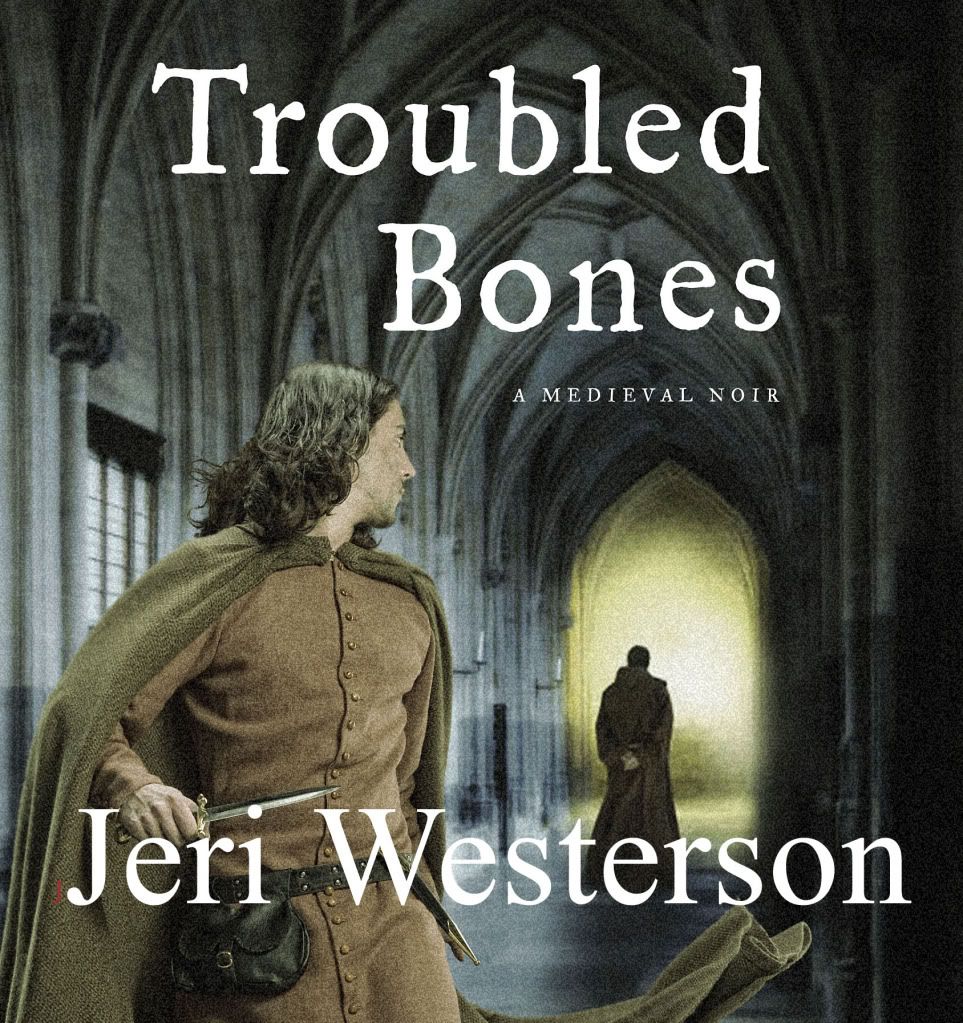 It took 300 Spartans to defeat the Persians. Into the Valley of Death rode the 600 in the Charge of the Light Brigade. But all I'm asking is a mere 200 of you and your closest friends to purchase your copy of Crispin Guest's newest adventure, TROUBLED BONES, the week of its release. That's October 11 through October 17. Not that it's a bad thing to preorder it. Or even buy it the weeks and months after. But if at least 200 show up to buy it that first week of release, it makes a smashing impression with the Powers That Be. And we want to make a good impression.